Ann-Marie Utz: In addition to digital and social media, print remains an important factor. How can we support customers that continue to rely heavily on print?
Sven Gösmann: Print is shrinking, but it still remains profitable and relevant. Many publishers aggressively scaled up their digital operations initially and then realised that reach eventually hits a plateau. This has led to a new balance: continuing to develop digital while simultaneously strengthening print. We responded quickly by curating our offerings more carefully and delivering them with precision. One way we do this is by providing a structured selection of the most important pieces in clearly defined categories, so that newspaper editors can plan their issues efficiently and produce them on time. At the same time, we deliver texts in appropriate lengths and formats so that print production can increasingly run in an automated or semi-automated manner. This isn’t just a question of product, but also of process: We need to understand our customers’ production logic so that our content fits seamlessly into their workflows. Just a few years ago, I wouldn’t have expected print to regain such strategic importance in this form – also because print reaches target audiences that are highly relevant socially and politically.
Ann-Marie Utz: Does this also change our products? Do texts need to change to remain future-proof?
Sven Gösmann: That’s already happening. Newspapers – including e-papers – are evolving in the direction of daily magazines: less a series of news items and more analysis, explanation and context. In a complex world, concepts and connections have to be made understandable, often very quickly. When a region or topic suddenly pops up, readers need guidance: What has happened, why is it important, what does it mean? We provide this contextualisation extremely quickly – and that builds trust.
Ann-Marie Utz: When we talk about trust, we come back to verification. Is this an area where we can provide even greater support to our customers?
Sven Gösmann: Absolutely. Accuracy is in our DNA. In the past, the focus was heavily on being fast – but always with the commitment to being accurate. With AI and the growing volume of content, this is becoming even more critical. That’s why we’ve expanded our techniques and training programs and brought them widely to the market. Thousands of journalists have already been trained, and it’s not just about traditional verification, but increasingly also about understanding and applying AI in everyday editorial work. Hardly a week goes by when our trainers aren’t out on the road, helping to make the opportunities and risks tangible. I’m fundamentally optimistic about this: AI offers enormous opportunities when used responsibly.
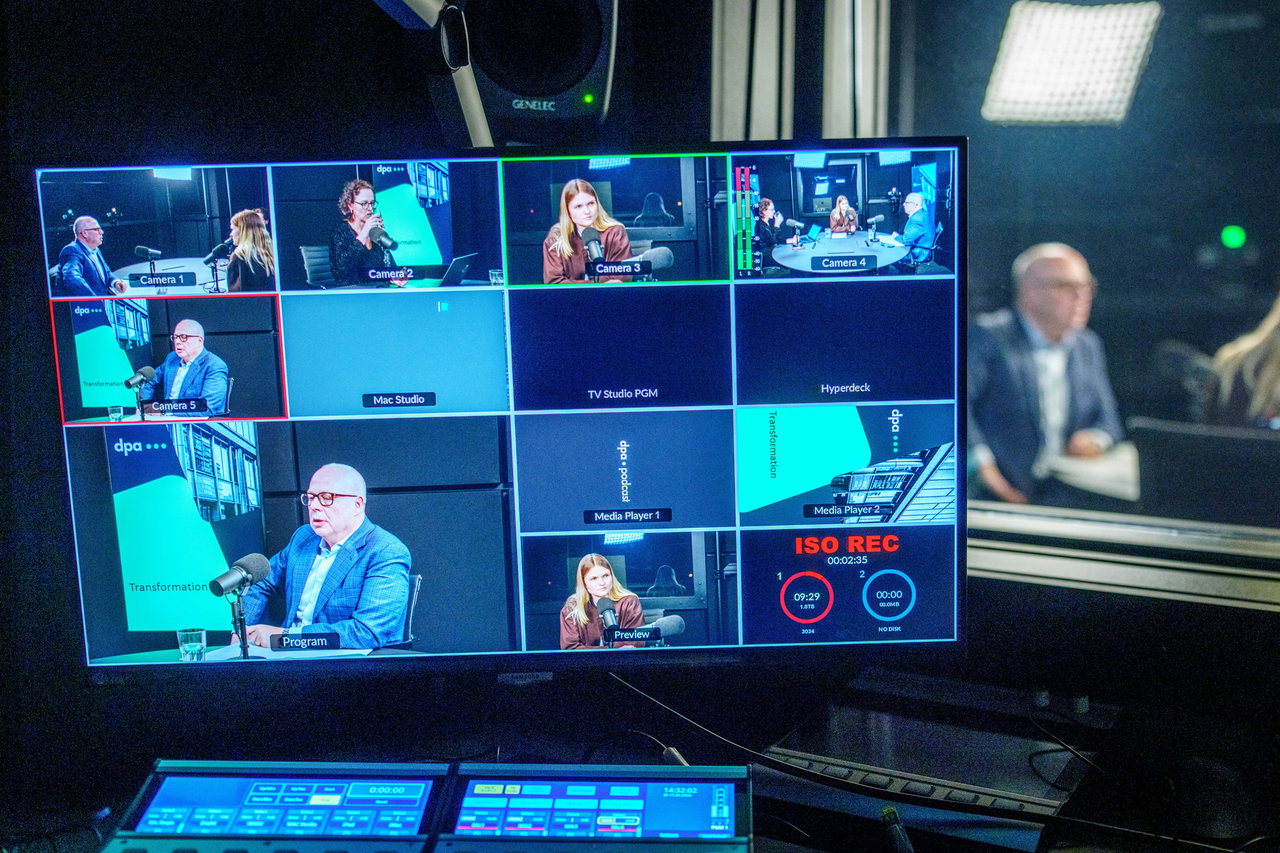
Ann-Marie Utz: Astrid, what has changed internally over the past year, particularly regarding AI? What skills are we building?
Astrid Maier: A key step was establishing clear AI guidelines. We began formulating rules and standards early on, and this has even garnered international attention. Building on this foundation, we launched internal training in 2024, subsequently integrated AI functions into our CMS and developed AI-powered products, such as a research assistant capable of generating summaries from our archives and live news feeds. Now, with dpa-iq, we’re bringing a new offering to market, in which customers can use AI interfaces to retrieve data from our archives as required for agency workflows. It’s important to note: We’re also not “finished.” Transformation is an ongoing process. We have to consistently anticipate what’s coming next and remain in constant dialogue with our customers to understand their needs.
Ann-Marie Utz: When it comes to the topic of AI, what should we provide customers with in the future – beyond individual tools?
Astrid Maier: It’s about a basic understanding. Not just “What can it do?” but rather: What’s actually happening there? How does an LLM work, what can this kind of system do and what can it explicitly not do? When is it useful for me as a journalist – and when is it not? If we manage to bring ourselves and our customers to a common level of expertise, a lot of potential emerges. And of course, it’s about integration into processes. With dpa-iq, for example, you can use content from our data pool, but also contribute your own content. Smaller customers in particular often don’t want to build their own AI infrastructure. So, we handle the infrastructure work, and you can combine your own content with dpa content. This allows us to generate automated products – such as morning briefings as newsletters, podcasts with or without an AI voice, and also probably formats we don’t even know about yet.
“It will be crucial to pay even closer attention to digital debates: What topics are resonating with people on social media? Where are narratives emerging? And how can we quickly translate these phenomena into verified journalistic outcomes? If we succeed in this, we will address a key pain point for many customers: finding one’s way through the information jungle.”
Sven Gösmann

Ann-Marie Utz: Sven, in this AI-driven world, is there an even greater need for journalistic guidance?
Sven Gösmann: More than ever. Newsrooms in many places have been downsized and are under cost pressure. At the same time, there’s a greater than ever flood of news. We have a foreign network that is virtually unparalleled in Germany. This expertise is a treasure that we must preserve and put to effective use. And we should remain open to input from customers – good ideas often emerge locally and then prove helpful to many. It will be crucial to pay even closer attention to digital debates: What topics are resonating with people on social media? Where are narratives emerging? And how can we quickly translate these phenomena into verified journalistic outcomes? If we succeed in this, we will address a key pain point for many customers: finding one’s way through the information jungle.
Astrid Maier: Verification has always been a news agency’s core task – and it’s gaining even greater significance in the current phase of transformation. Because with the growing number of AI-generated videos and photos, the risk of targeted forgeries is also rising. Against this backdrop, we have further developed our offering: The previous Infokanal has become “Info & Verifikation.” Through this channel, our customers can provide us with specific tips – for example, if they suspect that a photo or video circulating online might be manipulated or completely fake. We take these kinds of tips and examine them with specialised teams and image forensics expertise. We then make the results available to our customers. We expect the demand to grow in this area.
Ann-Marie Utz: When we look back in five years’ time: What role do you think dpa will have played in the transformation?
Sven Gösmann: I believe dpa will stand as a beacon and provider of reliable information. It won’t just be about delivering ready-made content in various languages and formats. It will be more about highlighting significance: “This is important. You need to know this. This is what we know about it.” And in a figurative sense, it will require a “notary’s stamp”: a traceable, journalistically verified classification that can be trusted. Guidance is becoming increasingly important.
Ann-Marie Utz: Astrid, what would you add?
Astrid Maier: First, helping to stabilise our customers’ existing business – that is, serving print and digital offerings in an effective way – and second, simultaneously empowering customers to develop new business models. This is also a transformation effort for us. Today we offer a product range that has never existed in this breadth before: from print packages and T-shirt text sizes for our traditional print business to data points via AI interfaces for automated workflows in the AI information infrastructure. Maintaining this balancing act – between tradition and innovation – will be the central task of the coming years.
Ann-Marie Utz: If you could give our customers one sentence, a motto for the transformation – what would it be?
Sven Gösmann: At dpa, I have seen it time and again: There’s more talent than you think. People can familiarise themselves with new topics and turn them into journalistic products. There is no lack of spirit, but often a lack of room for manoeuvre and responsibility. If media organisations manage to nurture talent and give them responsibility, they will have a bright future.
Astrid Maier: Many companies in Germany think in terms of old structures because they’ve been used to doing that for decades and it used to bring a lot of success. We have to break free of this together, try new things and keep moving forward. Standing still is riskier than any experiment. If you stand back and observe for too long, you’ll miss the opportunity to jump on the bandwagon.
Ann-Marie Utz: Many thanks to you both.
Astrid Maier is deputy editor-in-chief and head of strategy. Before joining dpa in 2023, she held leadership positions at Manager Magazin, Wirtschaftswoche and Xing, among others.
Sven Gösmann has been editor-in-chief of the German Press Agency since 2014. Previously, he was editor-in-chief of the Rheinische Post and worked for Bild and Welt am Sonntag.
Ann-Marie Utz is a dpa editor in Berlin and a trainer on journalistic AI topics. Prior to that, she completed a traineeship at the news agency.