TURNOVER IN THOUSAND EUROS
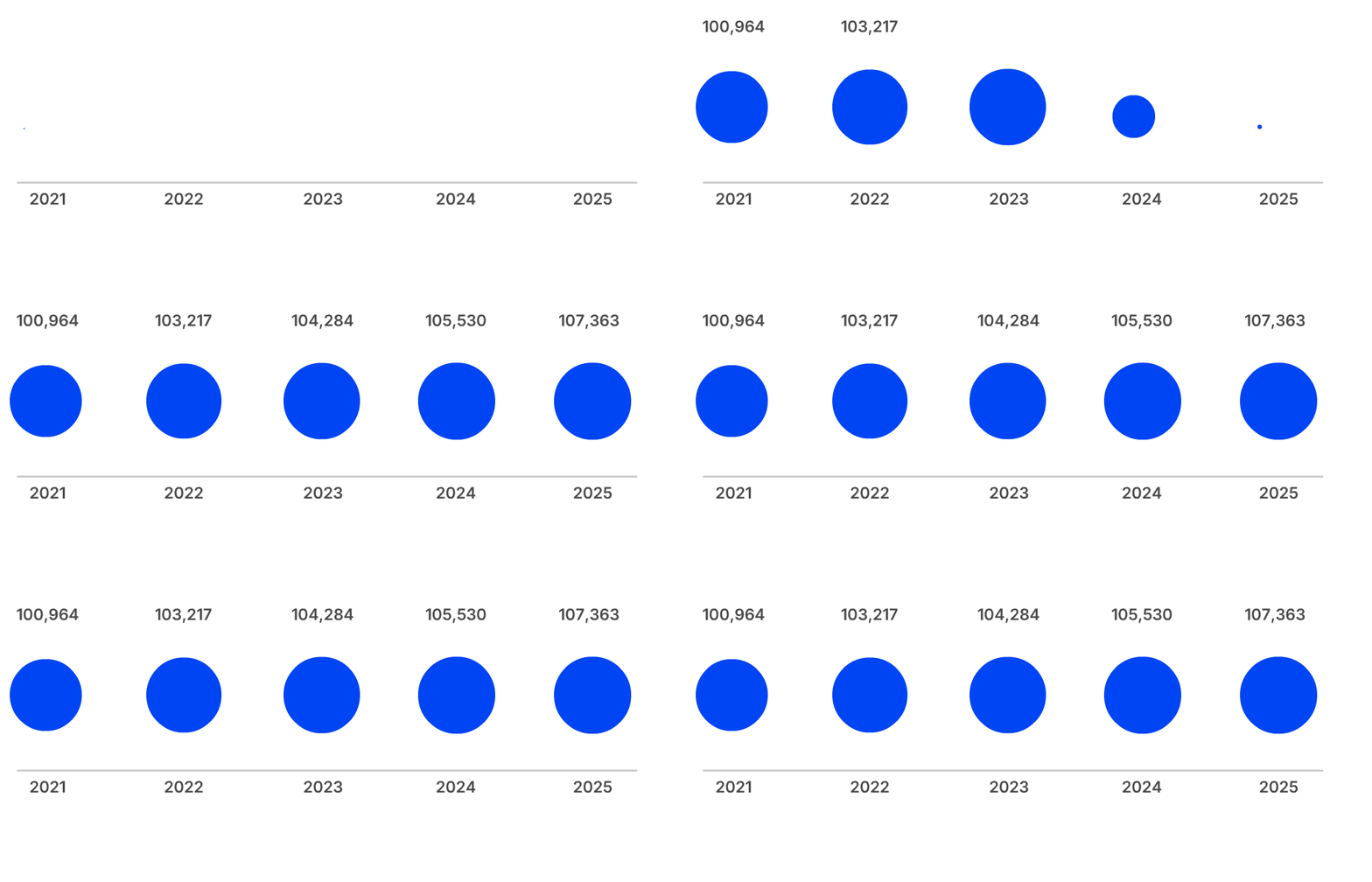
Despite a challenging market environment, dpa GmbH succeeded in increasing its annual turnover; however, reclassifications within the group also had an impact.
The results of the ARD/ZDF Media Study 2025 show that daily media usage time in Germany remains at a high level, averaging just under 390 minutes per day. Compared to the previous year, total usage time remained largely stable. However, the long-term trend towards the use of non-linear and digital offerings continued. While use of linear media such as television and radio continued to decline slightly, media libraries, streaming services, online video offerings and digital news formats continued to gain in importance.
Findings from the Reuters Institute Digital News Report 2025 confirm the ongoing shift in news consumption toward digital channels. According to the report, 66% of adult internet users in Germany access online news at least once a week. For 42%, the internet is now the most important news source, nearly equal to linear television (43%). Digital news consumption continues to gain importance, particularly among younger demographics. At the same time, trust in news remains mixed overall: About 45% of respondents say they generally trust most news, while more than two-thirds of respondents actively avoid news at least occasionally.
Both internationally and nationally, the situation for journalists remains tense. Worldwide, the number of imprisoned media professionals remains high, as does the number of those who have been victims of violence in connection with their work. In Germany, too, assaults, threats and digital attacks on media professionals continue to be reported, particularly within the context of demonstrations and when investigating politically extremist circles. The human rights organisation Reporters Without Borders documented a total of 55 attacks on journalists and newsrooms in Germany for the year 2025. Although this figure is lower than the previous year’s level, it still highlights a tense working environment. In an international comparison, Germany fell from 10th to 11th place in the current Press Freedom Index.
According to the federal government, a total of 818 incidents of politically-motivated crimes against journalists were recorded between April 1, 2024 and November 30, 2025, including 89 acts of violence. Nearly half of these occurred in Berlin (406), particularly within the context of demonstrations. About one-third of the crimes were attributed to the far-right political spectrum. The number of cases increased significantly compared to 2023.
In addition to physical and digital threats, political, social and technological factors are increasingly shaping the conditions for journalistic work. According to Reporters Without Borders, the policies of Donald Trump’s second term are also affecting public discourse and the media landscape in Europe and Germany. Social polarisation is on the rise, while major tech platforms are receiving open political backing from the United States in their resistance to European regulation. These platforms have evolved into independent media players whose algorithmic systems play a decisive role in determining which content gains visibility and reach. In the process, algorithmic logic increasingly favours polarising content and disinformation; at the same time, internal platform fact-checking mechanisms have in some cases been scaled back or eliminated.
Additional structural risks arise from the growing importance of generative AI models. AI-based summaries integrated into search engines and platforms are increasingly diverting reach and advertising revenue away from original journalistic content, thereby jeopardising the economic foundation of journalistic work. At the same time, legal uncertainty persists regarding the training of AI systems with copyright-protected content, in those cases where no licensing agreements or partnerships exist. The result is that media companies face both economic and legal risks.