“Give trust and you will receive it in return”
Interview with Kirsten Heinrichs, Chief Human Resources Officer
Why is dpa a good employer?
The foundations of dpa are built on independence, reliability and journalistic integrity. This shapes both our products and our corporate culture. Anyone who works at dpa knows what they stand for. This shared philosophy creates a sense of meaning in our daily work, which I consider one of the most important factors in being a good employer.
How does dpa support specific employee groups? For example, young people or managers?
We invest in people in a targeted way at different stages of their careers. This starts with qualified training positions, traineeship programmes that really make a difference, and career development prospects that go beyond the first role. We don’t just want to train people; we want to inspire them. For managers, we focus on targeted development programmes that view leadership not as an end in itself, but as a service to the team. Overall, we consistently align ourselves with our understanding of sustainability: Lifelong learning is a core belief that we embed structurally.
What was the highlight for your department last year in terms of the “People” aspect of sustainability?
For me, the highlight was that, for the first time, we truly showcased the full scope of the People section in the sustainability report – with concrete data, targets and accountability. This is an important step: We are making ourselves measurable. We don’t offer nice words, but facts. In terms of content, I’m particularly pleased with the progress made in expanding our range of services relating to health and wellbeing in the workplace. This has a direct impact on people’s experiences every day. And that’s ultimately the yardstick by which we should be measured.
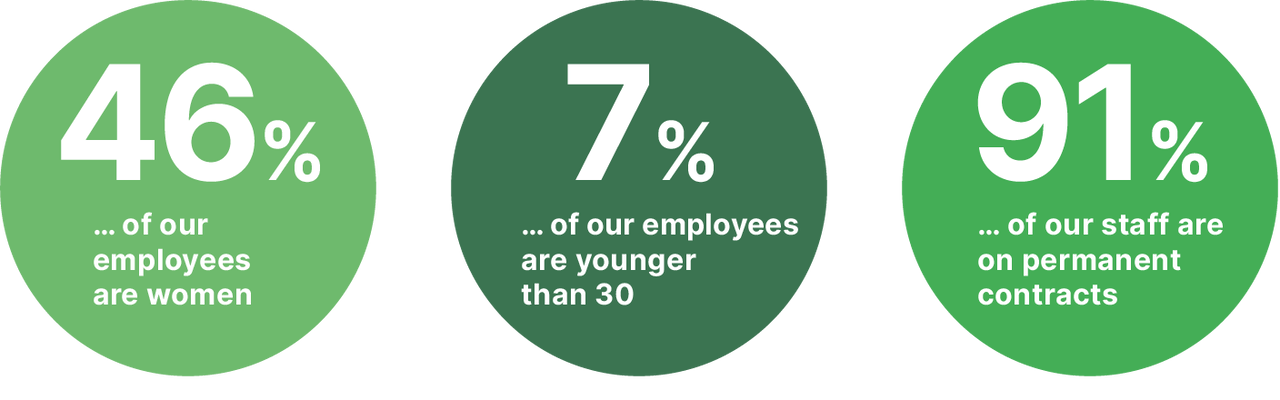
How do you view the current gender ratio at dpa? The overall proportion of women is 46 percent, and 38 percent at management level.
An overall proportion of 46 percent women is a strong starting point and shows that dpa is an attractive employer for women. At management level, we’re on the right track with 38 percent. At the same time, we want to ensure equal representation in leadership roles at dpa. This isn’t just a question of fairness, but also of quality. Diverse leadership teams make better decisions. That has been proven.
The staff turnover rate in 2025 was significantly lower than in the previous year. What do you believe is the reason for this?
A low staff turnover rate is the result of work carried out over many years: In the culture, in the quality of our leadership and in the development of opportunities that really appeal to people. I believe the experience of many colleagues in recent years has been that dpa is a stable, reliable employer in uncertain times. That fosters loyalty. At the same time, we’ve invested in so-called “new work” – that is in flexibility and autonomy in the day-to-day work life. Give trust and you will receive it in return, also in the form of loyalty to the company.
dpa is a training organisation. Most trainees stay on at the dpa. Why is that?
Because we take it seriously. A traineeship at dpa is not just a processing station, but a genuine door opener into a journalistic home. We work closely with our trainees, challenge them, give them responsibility – and at the same time make it clear: You belong here. When young colleagues realise that their work matters, that they’re valued, that dpa is a place where they can grow, then they want to stay. We do a great deal to ensure that this experience is not the exception, but the rule.
What topics is your HR team currently working on? Where can we improve things even more for the employees?
On the one hand, we’re pushing forward with the development of our services in the area of health and mental wellbeing. On the other hand, we’re working intensively to align our personnel development programmes even more closely with people’s individual needs. Moving away from a one-size-fits-all approach towards genuine development discussions and tailor-made programmes. And then there is the crucial topic of artificial intelligence: How are job roles changing? How do we prepare our colleagues for new demands – not as a threat, but as an opportunity? This is something we grapple with every day, and it’s one of the most exciting challenges I face in my job.
Where can we improve? Wherever people feel that their voice is not being heard. That’s what we’re working on – with even more dialogue, greater transparency and genuine care. Because, ultimately, it is the people who make up dpa.