
Waterworks, wholesaler, media group – what a history of dpa reveals
By Hans-Ulrich Wagner, media historian
The best-known image is certainly that of the “waterworks of democracy”. Wolfgang Büchner coined the term as editor-in-chief of dpa in September 2010. At the opening of the first Berlin newsroom – following the relocation of the central editorial office from Hamburg to the capital – he drew the comparison: “I see dpa as a kind of waterworks of democracy. We want to supply our customers throughout Germany with clean water from good sources.” Even back then, the aim was to prevent “poison in the form of deliberate misinformation” and to adjust the “filters and barriers,” the “measurement technology and alarm plans” at dpa accordingly. Carefully researched, verified news that met objectivity criteria was the core of the dpa brand and was intended to create the foundations for an informed public that wanted to negotiate its challenges in a democratic community.
Büchner’s image refers to “customers,” not readers or media users. The role of dpa as a B2B company means that the work and achievements of the news agency are not very well known to the public. Media studies research likes to use the image of the “wholesaler” for this role in the background. “News agencies,” as Emil Dovifat, the doyen of newspaper research, put it in the 1930s, are “companies that use the fastest means of transportation to collect and filter news centrally and deliver it to fixed recipients”. This role of the supplier will become part of a 175-year history in the “Year of News” 2024. In 1849, the publisher Bernhard Wolff founded Wolff’s Telegraphisches Bureau in Berlin and, together with the international agencies Havas, Reuters and Associated Press (AP), soon formed the big four cartel that determined the globalisation of news with a world news order until the early 1930s.
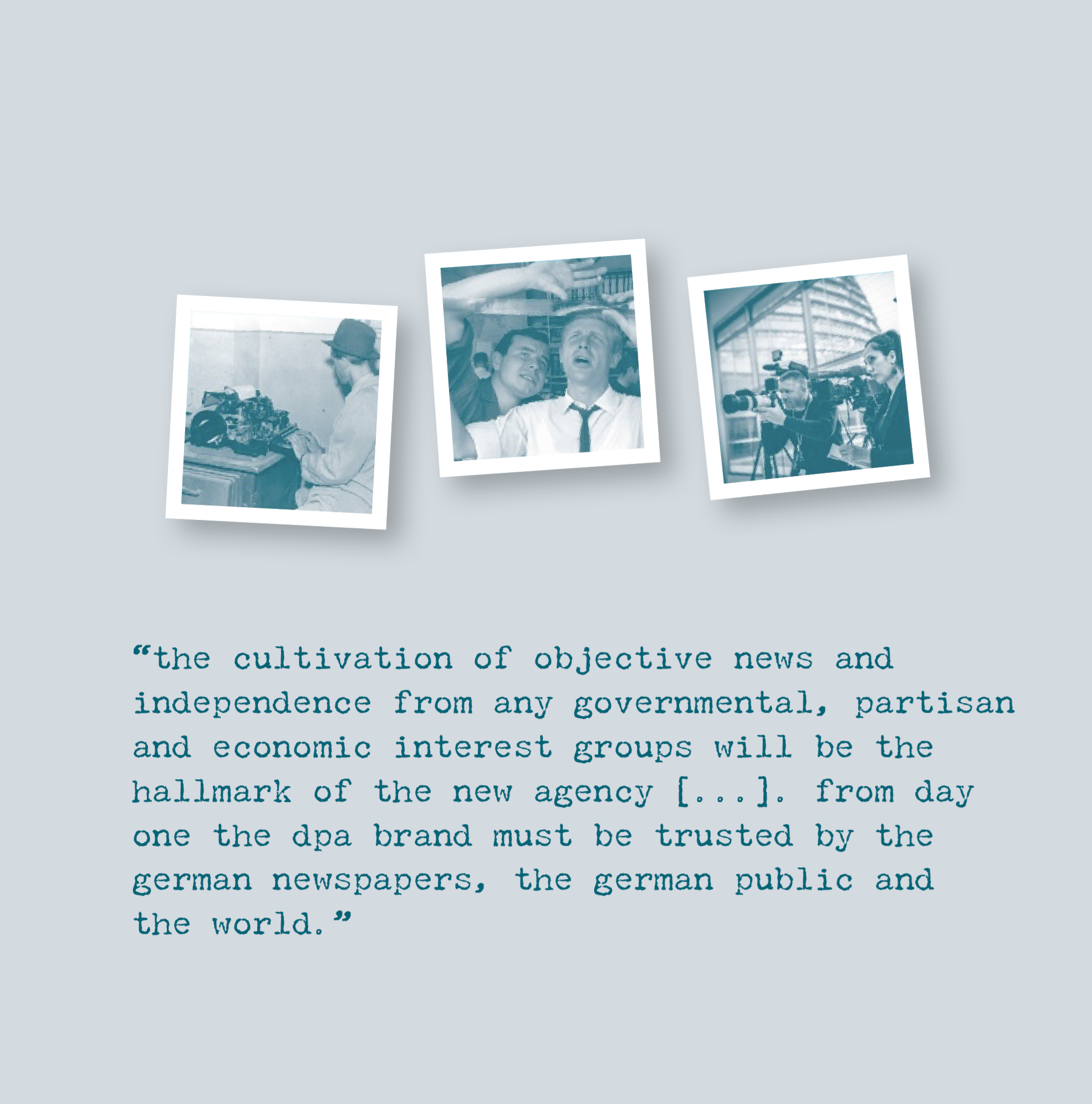
 With the end of the Second World War, the question of restructuring the media system, the press and the organisation of news agencies arose in Germany. From the experience gained up to that point, it was clear that a new news agency should not be subject to state control, as was the case with the German News Bureau (DNB) and Transocean (TO) in the “Third Reich”. However, it should also not be subject to free market forces and exclusively pursue profit-maximising goals. With the currency reform that was implemented on June 20, 1948 laying the foundation for a new economic order in West Germany and the history of the Federal Republic of Germany beginning with the signing of the Basic Law in May 1949, the Deutsche Presse-Agentur was born. The merger of the news agencies in the three Western occupation zones gave rise to the national news agency dpa, organised according to a cooperative model.
The most famous model for this was the eventful history of the Associated Press (AP) in the United States. Despite competition from private-sector agencies on the American and, above all, the global market, AP prevailed as a cooperative supported by various newspaper companies with the ironclad goal of objective news and an understanding of news as a “public good”. The Western Allied powers had this model in mind when they set about denationalising the news systems in the territories they occupied after the war and establishing newly founded news agencies as a “non-profit cooperative of its newspaper firm members”. This model was not only implemented in West Germany, but also in Italy and Austria with the Agenzia Nazionale Stampa Associata (ANSA) and the Austria Press Agency (APA), as well as in Japan, where Kyodo was founded as a non-profit company in November 1945, replacing the state agency Domei, which had existed until then.
When the federal elections in August 1949 paved the way for the constituent session of the first German Bundestag at the beginning of September 1949, this period of democratic reorganisation included the founding of the German Press Agency. On August 18, a notarised articles of association laid down the structure of this new company; on September 1, the first dpa report was sent out. This marked the beginning of an extremely eventful 75-year history for dpa. As a national agency in the Federal Republic of Germany, it had to assert itself in a highly competitive news market from the very beginning. As a media company of a very special kind, the news agency is subject to the structural changes of the entire media industry and has to face up to the current challenges. This is about nothing less than the value that news has and the value that it should have. After all, what is “objective news,” as the founding document states? How does one guarantee “independence” from the state and political parties, from industry and business? – an independence that is supposed to create “trust” and must be proven time and again.
This eventful history of dpa is traced from the documents in the dpa company archive, from many sources in other archives and from conversations with employees. It reveals the political struggles of a news agency in the post-war period and shows how a global agency emerged that offered the media industry a full range of foreign and domestic services, how the shareholders supported their news agency with solidarity and criticism, how dpa GmbH became a modern, broad-based media group that offers many services related to the core business of news. As a history of a media company, it shows how decisions were closely linked to political developments and how the search for economic stability forced those responsible to react quickly to changes in the media industry. As an agency history, it sheds light on how technical changes were seized and implemented for the news agency business, and finally, as a media history, it shows how the work of dpa employees took place against the background of social changes. The analysis of archive documents and testimonies leads to other stories about the agency, such as about Konrad Adenauer’s media policy and Fritz Sänger’s resistance as editor-in-chief in the 1950s, about the work of dpa correspondents abroad and in the German Democratic Republic, about false reports in the history of dpa and the internal handling of them, about the role of flash and breaking news, about dpa photos that made history, about project initiatives and the founding of subsidiaries as well as about relocations in the geographical sense and relocations in the mind.

Dr. Hans-Ulrich Wagner is the head of the research project “Die Geschichte der dpa” (The history of dpa) at the Leibniz Institute for Media Research | Hans Bredow Institute in Hamburg and is the author of the book “Im Dienst der Nachricht. Die Geschichte der dpa” (Serving the news. The history of dpa) published by Frankfurter Societäts-Verlag.