
Diversity
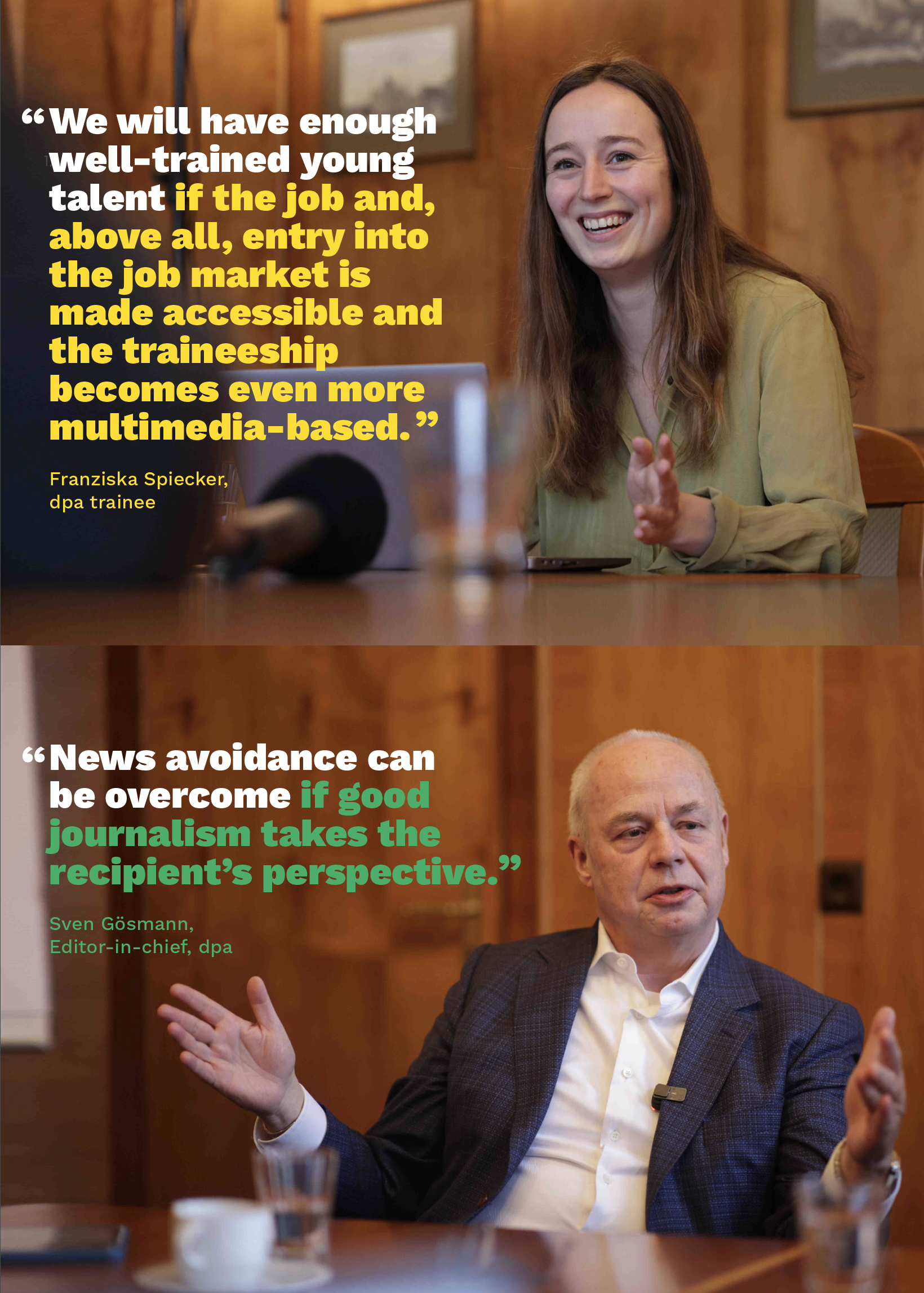
Franziska Spiecker: We also need more diversity, more diverse perspectives. One example that you often mention, Sven, is that we need more people from different social backgrounds on the editorial team. Why do we say that on the one hand, but then generally don’t pay for internships?
Sven: That’s a good point. Firstly, of course, there are financial reasons. And secondly: Who have applied for internships up to now? It was very much the same people.
Franziska: But that is connected. If the internship were paid, perhaps others would apply.
Sven: That could be a point that opens things up. We are too homogeneous in terms of social backgrounds. Too much city, too little country. We have to ask ourselves how we should organise the recruitment process as an employer. Paid internships could be one answer, I’m open to that.
Ann-Marie: On the subject of people with a migration background: I have the feeling that the goal is clear, but I ask myself: What are the strategies for getting there faster? Can a quota for people with a migrant background be one pathway? Or are there other concrete strategies in order to better reflect German society?
Sven: dpa is more than just the editorial department. I also believe that with the colleagues working in software development, for example, who we now have from India and elsewhere, a different corporate culture is spreading. One can consider quotas. I hope and believe that the pull effect can be very strong if you have personalities who are seen in social media, or simply because they take on a role.
Hilal: I think that we’re already in a much better position across the board and that the main change is needed in the editorial department. It’s often seen as a barrier if you don’t speak the language. I think that’s the wrong attitude. Language is no longer a problem in journalism. If you have language problems, you can ask ChatGPT: Do you see any grammatical errors here? And that’s less important in video because you’re not writing there.
Sven: The pure text-based traineeship no longer exists. Of course, someone who mainly takes photos or operates the camera no longer needs to master the intricacies of the German language. It’s different for colleagues working with text. I think that will remain an entry requirement, which incidentally is not a hurdle for all people with a migrant background. But the proportion of people applying for editorial jobs who are not called Müller, Meier or Schulze is relatively small.
Hilal: I want to pick up on that. I myself am a visible example. You have to take a structural approach. Otherwise, the burden – especially the emotional burden – remains with one person because they have to constantly explain things. I don’t know if a quota is necessarily the solution, but that would be a structural approach, for example.
Ann-Marie: There are also things that can be implemented in the short term – such as training in intercultural sensitivity.
Franziska: Another measure when it comes to trainees, which some journalism schools already use, is to offer support programmes for groups that are underrepresented in journalism. For example, with journalism workshops and tips for the application process to try and lower the barriers to entering the workforce.